 Weather today
Armenian, Azerbaijani FMs hold video conference

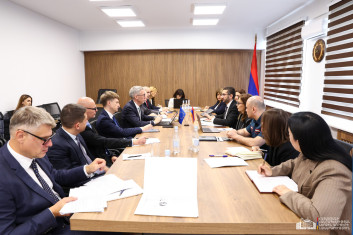
Foreign Minister Zohrab Mnatsakanyan is conducting a video conference with his Azerbaijani counterpart, Elmar Mammadyarov.
The remote negotiations between the two countries' top diplomats have attracted also the co-chairs of the OSCE Minsk Group (Stéphane Visconti of France, Andrew Schofer of the United States and Igor Popov of Russia) and the Personal Representative of the OSCE Chairperson-in-Office, Ambassador Andrzej Kasprzyk, the Foreign Ministry's spokesperson, Anna Naghdalyan, says on Facebook.
The agreement for today's talks was reached in the course of a video conference with the international mediators on Monday. According to the Foreign Ministry's press service, the discussion focused on the framework of issues dealing with the Nagorno-Karabakh (Artsakh) peace process.
--
The Armenian-Azerbaijani conflict over Nagorno-Karabakh broke out in 1988 when the Armenian majority of the then autonomous region declared its intention to break away from Azerbaijan. In a referendum held on December 10, 1991 (days before the collapse of the USSR), the population voted overwhelmingly in favor of independence (99.89%). The move was followed by Azerbaijan’s large-scale military operations against Nagorno-Karabakh and seven neighboring regions. The armed violence left around 25,000-30,000 people dead; thousands were internally displaced. The Ceasefire Accord, which went into effect in May 1994, formally put an end to the armed attacks in the conflict zone, but there is still periodic fighting in the area. Since 1994, the OSCE Minsk Group, a mission co-chaired by France, the United States and Russia, has been spearheading the efforts towards a peaceful solution to the conflict. .
The hostilities escalated to an unprecedented degree in April 2016 in what was later dubbed a Four-Day War. In the early hours of April 1, 2016, Azerbaijan's armed forces launched heavy offensives along the Line of Contact, provoking large-scale confrontations with the Defense Army of Nagorno-Kkarabakh. The adversary also shelled civilian settlements, particularly the southern and north-eastern regions of Hadrut and Marakert.
A ceasefire was reached on 5 April between the chiefs of the armed forces of Azerbaijan and Armenia in Moscow. The Nagorno-Karabakh authorities also welcomed the verbal agreement.





 Studio One